Monday, 8 September 2014

Highest Hipster Status

So this post's title comes from a quote from the video linked below, from a teen who's shown and plays on the Nintendo Entertainment System - NES - for the first time.

One of many 'Teens React To....' series, I stumbled across this recently uploaded episode when taking a quick coffee (glass of water) break from level editing of SpaceBoy - more on that later.


The episode came as a real kick in the teeth, for me, a 26 year-old, having been born 3 years after the release of the NES, and being first introduced to a video game console in 1992 with the Sega Megadrive, I still managed to find, purchase and play older consoles and computers in my pre and post-teens.
Watching teens of ages between 14 and 19 react so confusingly to a console that, as factually stated within this episode, essentially led the charge in the rebirth of the video game industry after the crash of 1983 disturbed me.
I never had a Super 8 Camcorder but I know what they are. The way most of the teens in this video react is bizarre to me, maybe it's age, or just bad parenting, OR as 'guest star' Maisie Williams from Game of Thrones fame states,

"We're just spoilt these days. As soon as someone creates something that's like super super efficient people won't stand for anything less."

I think she speaks with reason and makes a valid point, having a Sega Megadrive hooked up to the only tv of the house in the early 90's was about as good as it got, now people have access to Megadrives, NES', SNES', GameBoys, and every other retro console emulated to their phone or tablet. Not that they'd know what consoles they were. Bastards.
I think we're all a little spoiled, having access to video games almost immediately with downloads and the ease of access to apps and online stores has created fickle people out of us. Play one game for a few minutes then done, onto the next one please, thanks. Fads. I hate fads. Not just in video games, but it seems that people of all ages play video games now, without realizing.
As Charlie Brooker suggested in his 2013 TV special, 'How Video Games Changed The World', Twitter, and social media networks are essentially video games. Posting on Facebook and observing likes and comments are themselves rewards, as close to earning money or points within a video game.

But to the point of the video.

As I watched this episode I noticed how cleverely structured it was, for the teens reactions caused fleeting reactions from myself. One minute angry, the next melancholy, and after that gracious. To the few that didn't understand nor care how the console functioned back in the 80's and 90's, there were also positive and enlightening responses, such as,
"It's a classic, like a classic vinyl record; this is like a classic vinyl video game", and "Today, if you had one, you'd be the coolest person out of your friends... you're gonna get like the highest hipster status ever".

And there we have it. 'Hipster'. A piece of my youth is now 'hipster', the console's come full circle somewhat and is now suggested to be 'cool' again, and something to have and brag about.
This greatly influences gaming today, at least within the 'casual market', as old video game design, blueprints and styles are as popular as ever, and are often created to replicate that old 'retro' and niche feel.

Some other highlights of the video for me were when each and every teen couldn't load the game cartridge for the first time. On the beautiful old CRT television, the screen flashed green, in the suggestion that an error had occurred, and even though the console's power was indeed on, something else was a miss.
The teens were then informed that kids of the cartridge generation - pre-CD era - used to blow the cartridge, removing any dust or wrongdoings the sweet and innocent game had collected throughout the time it wasn't being played.
A realization, again, the teens reacted to confusingly. Although 'blow the cartridge' was apparently unearthed as myth, the teens correctly diffuse as once they do the game works.

One commentator of the video, 'ElWaster', posted,

'I might feel old, but I feel a bit of joy knowing that I have experienced an extreme amount of fun at the beginning of an amazing form of media that these kids never will.'

Monday, 9 June 2014

Bare With These Basic Bits, Because Basically I'm Bloody Besotted By (space)Boy

Alright.

A few screenshots, very basic, of very basic action (and non-action) going on.


As stated above, these screenshots merely reflect a quick example of the colour-to-b&w of SpaceBoy, in and out of light, the effects of 180 degree gravity when jumping in these beams of light, and a general overview of a basic set of platforms, split up by a teleportation system (green orbs).

The style is highly untouched, overall, from the original level designs from my project last year - albeit altered compared to the first few concepts I ever created for the game proposal.
Tiles have been created, multiple 128 and 256 tiles that represent grass, rock, bushes. Speaking of which I've created a list of tiled assets needed for the entire project.

Details, coming, later.

Cliffhanger.

Slave-unky

I feel sick just thinking of the word.

Spelunky.

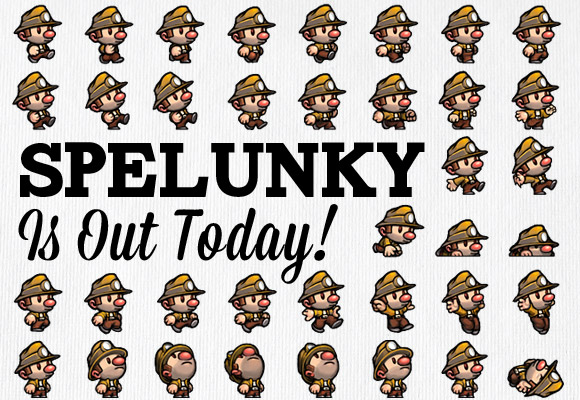
Never has a video game both encapsulated and infuriated in such equal measure as Spelunky.

From level 'Completed!' to 'Game Over' in an instant, Spelunky's game design is specific, dynamic, classic, modern, rewarding, punishing. The best, or worst in equal cases, of both worlds Spelunky's design provides, with consistently emotional, toe-curling platforming.
Yes, platforming.
It seems rare these days to suggest that an old-school genre such as the platformer or sidescroller can produce such tense, blisteringly difficult and belligerent feedback with it's design and mechanics, while still seducing enticing, rewarding and addictive gameplay.
60 hours I've played Spelunky so far.
60 whole hours of my time, patience, swearing and sweating dedicated to a game I have yet to fully complete once.
The design of Spelunky is random, in the sense that through the designer's blueprint, levels are created at random - albeit based on a programmed sense as to always create a path from start to finish, and to include enemies, hazards, jewels and items that are obtainable either by platforming or via two of the game's key items - the bomb and rope - of which a player will start the game with 4 of each, including hit points.

As the level's are random, it's seemingly initially difficult to create a structure and path in your mind based on experiences of dying at the hand of a wildly throwing yeti, a man-eating plant or a shotgun-wielding shop keeper.
In Spelunky everything is out to get you, and believe me - it will. Anything that is done wrong is you, the player's fault, as infuriating as it may at the moment be. Hell, I've just died after reaching this game's boss level, defeating it and then falling into a pit of lava trying to escape the level through the doorway to Hell - the game's final, hidden set of levels.
Hell subsequently also reveals the game's true boss, and the quests you must partake in to get here? Daunting. Ridiculous. Impossible. In order to reach Hell, the player must do a specific task within each area that then unlocks the ability to achieve the next task in the next area. From carrying a gold key to a large, padlocked chest, to dying on a specific level within an area, to be reborn within an impenetrable statue - providing a key item only obtained within this statue.
The concept behind all this - on the surface - seems somewhat basic, and thus achievable, and the latter is correct, I personally within the 60 hours of playing Spelunky have reached Hell twice, defeated the FINAL final boss, to then again fall into a pit of lava as the exit was open, waiting for that 'RB' command on the XBOX controller to be pressed to enter and finish the game.

The design around Spelunky is simple yet precise, and varied. I was initially overwhelmed by the amount of achievable ways I could explore and concur a level, and plotting ahead was itself a reward as often the game can be playing perfectly until - dead - before the final hurdle. It can happen so fast that reaction times cause a sudden rise in panic, almost like a traditional haunted house or 'jump scare' from a horror film/video game.
I dread to go into detail of the ways the player can die within Spelunky, as so far for me it's around 400, with 3-4 game finishes.
1 of every 100 I finish the game, statistically, and that's the basic game, not the fully rewarded Hell levels.
Within the design choices are the simplistic player controls - emulating video games from the 80's and 90's, your character can run, jump, sprint, crouch, grab, through and shoot. A concept that's then deeply explored throughout many of the items and pickups found within a level.
Vases are always present within Spelunky, housing either small to large chunks of gold, enemies or simply nothing.
This risk/reward system, even within something as small as a throw-able vase is present, and proves an analogy for the game as a whole. One minute an item can be a gift, and then within one foul swoop - becomes the curse. A shotgun for example, provides slight kickback - so strategically and over time this, and varies over objects and items will be mastered in how and where to use, '..is this going to fire me off into these spikes if i shoot the oncoming attack' scenarios are forever present. How and IF an enemy is killed is also sometimes a daunting task in itself, does the concept of killing this creature reward with an alternate path, a pickup, an obstacle for another..
All these thought processes and moves are always considered and implemented by the player, and when running past two and a half minutes on a playthrough, the player is greeted with a slow-down, almost haunted version of the level's theme music and an actual ghost, that appears from one side of the level that will slowly float straight towards you; killing when connecting. The sense, therefore, of urgent consistency and time spent collecting money, killing enemies, saving damsels and avoiding traps is perfectly placed within these small yet challenging and randomly generated worlds.

Also the aesthetically pleasing elements of Spelunky; the graphics, the music, the references and the secrets to be explored in this small games are itself a reward. The music replicates traditional 80's/90's platforming midi-esque beats and rhythms, catchy and memorable - capturing the level environment with each perfectly placed snare, whistle and key - suggesting to the player the kind of level and experience they're bound to have ahead of them. Essentially selling itself as an Indiana Jones-like experience, the gameplay borrows and highly incorporates traits of Steven Spielberg's classic franchise within a linear, yet varied 8-bit platforming game.

Spelunky was first introduced to me via Indie Game: The Movie, which mainly concentrated on the stories of designers on highly successful independent releases Braid, Fez and Super Meat Boy. Upon the release of additional hours of footage, I was provided with a few character concepts of the - then unheard of to me - Spelunky.


This image, right here, brought me to the page and video of Spelunky's release within Indie Game: The Movie Special Edition.


This is all for now, I better get back on it..

Monday, 12 May 2014

Level Designing and Story Telling, Yo.

So yeah.

May.

I've avoided writing up my progress because of, essentially, being too wrapped up in it to really study.
That was wrong, and without this I feel I've missed the essential summation of work every week or few days like I did previously all those months back.

Essentially creating a piece of work(s) and putting on this glorious blog of mine for discussion, reasoning and analysis as to what the work represents within the project and within my current mind frame. With the latter, I mean how other work's consistently influencing and re-molding my SpaceBoy project week after week, game after game.

But enough of that.

SpaceBoy's last outing on my blog was in February; an analysis of level design styles and methods, of which I'd have potentially adopted to fit the gameplay and pacing of what I wanted SpaceBoy to play out like.
Tile-based level design is great - a wonderful reflection and reference to old-school game design, of which has served almost perfect examples of platform games with it's mathematically 'correct' tilesets and sizes for old 80's and 90's video games.
This I worked on for a while, though I was struggling to convert a natural, modern looking environment with old-school block-specific design.
So I decided on the Limbo/Braid-style, of which rectangles within the game engine could be shaped, copied and pasted to create basic platforms, of which the player would perfectly assign to - as collisions are perfectly assigned from the moment of the shape's creation - as opposed to self assigning collisions through tile designs imported in through Photoshop.


Above is the video game Limbo, a work-in-progress selection of screenshots designed the game's level designer; Jakob Hansson.

With these screenshots Jakob writes;

Below are some work in progress screenshots of levels I created using our level editor.
I stopped at Limbo after the basic game play, level design and puzzles were created,
so most of the graphics layers were created afterwards.

And some artwork that closely resembles in-game screenshots;


With the art style visible, the designer then showed technical aspects to the level designing approach;


And with this; established level design for SpaceBoy is confirmed - natural looking environmental pieces created with multiple, alternately-sized rectangles is a much more sound method in creating SpaceBoy.
With the above, Jakob runs through and slightly discusses the intentions and use of colours, giving the user a grasp of the level flow and pacing through trigger and mechanic placements.
He suggests that the aesthetically pleasing elements; such as the designs of the artwork above suggest, like completed grass, rocks, trees - are added after all these basics are created;


And with this I have taken to the game engine - Construct 2 - to mock-up basic 'tests' of consist of platforming and mechanics needed for the final demo.
The creation of in-engine rectangles, and the copy and paste - there of - is essentially an easier and much quicker way of mocking up basic and soon-to-be fully realized level designs, that encapsulate the freedom of differently layered surroundings, as opposed to 32x32 grid-like tiles.

This, in reference to newer styles of level design, counters traditional and often primitive tile-based design. However, not to diss this tactic; as a lot of well established video game franchises - old and new - still implore these design ethics and as such produce some of the finest platforming games ever made.
For SpaceBoy - so far - this cannot be done, if I'm looking for a Rayman-like, modern platform-puzzle game based around organic environments and backdrops.

If anything, the tiling will come to fruition with the artistic layers over the basic rectangular platforms, such as the image above suggests - tiled grass can be copied, pasted, rotated; to fit/blend in with the solid ground; giving the illusion that the player is running atop a grassy path.

Animation-wise, SpaceBoy is in it's 'final' stages of design, were 'rough' and 'better than rough' (terrible alternate) served as blueprints and implemented ideas that showed how he would run, jump and generally interact when the user interacts with the controller/keyboard.
With black&white being a primary colour scheme, SpaceBoy and indeed most of - if not all - the environments will emplore this style, with potential occasional colour within some parts of the proposed release.

The story has developed somewhat, originally playing out as a 'get from A to B'-type iPad game involving puzzle solving speed around light and dark, the project then evolved into a traditional platform game, with it's black&white visuals - white outlines of characters, props, environments - becoming a staple and perfect style choice. The game was originally set around SpaceBoy, roaming from planet to planet, saving each by restoring light through specific landmarks. The light within these planets had been taken so abruptly that they all quickly evolved into mere outlines of their former selves, and thus only SpaceBoy remained colourful when in light.
Although most of this is still relevant, SpaceBoy now has somewhat of a sidekick, in the form of a large super computer named S.O.N. (Super Operating Network), who serves within a small identifiable ship that they both originally arrive in.
SpaceBoy is Master Chief-ed up (frozen) until thawed when landing on a mysterious planet. SpaceBoy then begins to realize - as you play through the desolate ship - that things are indeed odd, and slightly a miss. Learning the basic controls and mechanics as you play, SpaceBoy encounters and powers up S.O.N. who then reveals that the planet's riddled with 'glitches', and the ship has essentially been dragged down and ceased to operate, until SpaceBoy solves and demolishes these problems.
Glitches are essentially now the main antogonists of the game, and serve as boss-like encounters within glitched environments leading up to their reveal. These glitches have also demoted S.O.N. to a mere DOS-like interface, and with every glitch destroyed; so S.O.N. can upgrade and aid SpaceBoy further.
Darkness still plays a major part within the game, tarnishing SpaceBoy's body heat health - of which heals when in light - but it's now glitches that dwell within the darkness, and if within the wrong area for too long, SpaceBoy himself can get infected and appear to become glitched - THUS my previous posts from Feb and Jan - animations there of.

That's it for now. I like to close things off abru....


Thursday, 6 February 2014

Level Design Moderation

Today I done found a beautiful article based around 2D level designs, alternate in scope, finesse and construction, but all profoundly relevant to my recent exploration of GOOD design, use of pacing, narrative, structure, humour, originality and personalized imitation.

For me, personalized imitation is the concept, design and working application of something, based on something already present. And with this I've been racking my brains, trying to establish a level design-based narrative, that would appease the concepts and designs of SpaceBoy throughout this and last year's work, and reflect on my best work aesthetically and technically.
I've considered modular asset-construction, as I did with LIMA, and indeed of which is practiced in a lot of video games; it saves memory usage and can be easily replicated (copied and pasted) throughout environments with alternate textures:


Tiles used with Sonic 2 for the Sega Megadrive. Blocks such as this can be replicated or alternately textured to fit with the level's surroundings.

I've, however, always considered SpaceBoy's level design to be quite organic, in it's shape, thus having a completely random style; unique to specific situations.


This representation of design, and it's process, shows the workings, rough and in-game layouts, but all based around large, odd/uniquely-shaped platforms.

Though, as the developer suggests, the trials and tribulations of such design incur slow frame-rate and heavy use of memory, of which had to be constantly and consistently tampered with to fix.


'After getting the graphics and adding them to levels, we found that the game ran at about 1FPS. Which was a slight issue. This brought us to the stage of optimizing, refactoring, and rebuilding all of the levels to work with graphics. In the end all of the level graphics are pre-cached as tiles of bitmaps (starting as vector to save download), as the level might be up to 20,000 x 20,000 pixel in some cases.'


Thus, with construction of modular-based level design began - based around a mockup background grid showing 512x512 each in an 4096x2048 file - I discovered that even a rough design wasn't enough.
So I resorted back to paper.
Not with design, but with words.
I quickly devised a rough 'Level Design Method' of individual design styles to see and discuss which one would be most beneficial for SpaceBoy, yet also incorporating the essential additional charming and medial elements.

My write-up:

ZELDA STYLE
- Open areas, small sections throughout, surrounding puzzle-based cave areas.
- New areas unlocked when power ups/items are found; thus can access the previously inaccessible through rock-smashing, or wall climbing.

RETRO SONIC/MARIO STYLE
- Level to level; each level is unique, the same narratives/design aesthetic within one zone/world until the next is unlocked - level selection (specifically Mario) accessible throughout, for repeated plays.

METROID STYLE
- Like Zelda, but entire game plays like the player is in the Zelda-esque cave.
- Sections unlocked also through power ups, but the entire world plays out as one big level/maze.

LIMBO STYLE
- Puzzle-based areas are connected together with atmospheric, aesthetic areas - areas which serve the purpose of running through perfectly placed environmental pieces and scenery, opening up the next puzzle.
- Game plays out as one large level; surrounded by and discovery-based narrative and wonder.

SUPER MEAT BOY STYLE
- Quick arcade/pick-up-and-play design; often displays the player's start and goal of a level within one screen, as opposed to the traditional scrolling of the camera.

SWORD & SWORCERY STYLE
- RPG platforming, where environments are the narrative, and are explored and unlocked through interaction.

CURRENT INDIE GAME STYLE
With that title I'm not stating all independent games follow this process, it's a mere title that I've used - as I've used with the other ones - to easier understand the principles of each, or as a rough guideline.
- Style, charm and use of design techniques over technical level design; aesthetics over gameplay.

I discussed the latter 'style' with some friends and determined that by that I meant it not as a negative, but as an alternate current style used to show of unique and wonderful design styles, over basic level design. With this, however, I noticed that playing games like this actually quenched my thirst for exceptional level design with it's artistic approach. Instead of 'style over substance', the style almost in fact BECOMES the substance, at least from a sharing of experience point of view.


And with these fresh in my head I began randomly creating alternate non-essential scenarios - comedic and/or charming elements, if you will, to heighten the sense of uniqueness and creativity, instead just another platformer.
Scenarios of which, that include interactive characters - one of which I sketched originally as a super computer, based around the old-style PC's, that would act as a sort of mission-briefing, but also engage in talks with the character, as though it had itself formed an almost human personality - I was thinking HAL 9000 from 2001: A Space Odyssey and of course GLaDOS from the Portal series; of which, the character's portrayal is that of mystery, it's seemingly helpful and curiously clumsy - giving the player an uncertainty of if it's on your side, or has alternate agendas.

Although this is only a small asset, ideas are then spawned from them, and thus designs evolve and the entire game's narrative and plot-development become something more than just mysterious or generic.


Almost forgot.


The Guide To Implementing 2D Platformers


(The website based around the introduction of this post. Still reading.)


Friday, 31 January 2014

Frankenstein's Monster


IT'S ALIVE!


I'm wanting to incorporate a multitude of classic references, such as Pong above, within SpaceBoy's idle animations.


Thursday, 30 January 2014

Idle Animation Mock-ups

Some generic idle animations.

Cheers.


Testing

My post titles have been severely uninspired recently, but judging by the SO FAR title of 'SpaceBoy'; what do you expect. My laziness is just even more visible, is all.

I've been talking with my buddy Oliver - the fella who's helping build the game, via Construct; to keep you in the loop - and he shared with me some builds based around the gravitational mechanics and low-grav/flip-grav/teleport beams throughout the game's design.
With these builds we've discussed camera work - whether it should/shouldn't track the player when the world has flipped, yet, keeping it on the player when in hamster ball-type areas, gravitational triggers - 'press space-bar to flip gravity' - and area zone in which the player can manipulate their gravitational powers.

With these 8 tests firmly in place I've maneuvered swiftly back to animations and, to quote my tutor, "make it look pretty" through potential in-game art and design.
I also managed - again, with the help of my tutor - to alter the image size of SpaceBoy to pixelated, and back again; to give off a glitch-filled feel.


Forget the unregistered shit above the animation; the software was used in order to quickly put the PNG frames together and thus show off a quick mockup of a glitched SpaceBoy running sequence.


Another quick mock-up of an idle sequence 'glitched'.


SpaceBoy in 'prone', transitioning from normal to glitched and back again. The static-like animation references the Wreck It Ralph style of jolty animation (see below).


Notice the minor characters - the ones dancing - and even Felix's walk, reference old-school video gaming it their animations; as though frames are missing, as they jump from one position to another. This is the style I hope to somewhat incorporate within SpaceBoy.


Friday, 24 January 2014

Glitch Generator

SO.

One of the new mechanics - well, altered mechanics - is the addition of the 'glitch'.

The glitch resides in the darkness, and takes over SpaceBoy if he resides in there for too long, eventually turning him into a glitched version of himself. Well, severely pixelated. As a form of metaphor towards wanting to escape the old-school pixels for the more modern, HD-in-an-app look, or whatever.
Glitches, mainly, class as boss battles, and surrounding areas will become tainted by 'glitchiness' (dictionary, without a doubt in there) as SpaceBoy nears them.

With that in mind, I've tampered with how the glitch-look will appeal, and how - indeed - SpaceBoy will look when glitched.
I found a 'create your own glitches' website, that allows you to open up a JPEG image and randomly - or by your own control - glitch the hell out of it.


For example; normal and glitched, respectively.


As you can see; the imagery becomes more and more obscure and off, even creating colours that weren't within the original incarnation of SpaceBoy.
They serve as examples of possible side effects of 'glitches' found within the game's design.
It will be fun (frustrating) to see how these play out within basic animations such as movement.


GLITCH GENERATOR LINK


Back To The Concepts

So, I'm going to start another post with 'so'.

So. I've reverted back to concepting. Pen and paper-type shit, y'all. Old School.
I used to traverse, from paper to Photoshop on what I found best with concept work. It even got to a point where designing characters, objects, environments, level designs was much easier on Photoshop, than paper. But as of this week I've gone all traditional and summoned out the pen and paper. I draw better with pen, as any errors in drawings or spelling is forever imprinted in front of me, as a learning/guiding process to avoid such things with future tasks.

I knocked up a 'test list' - of which is exactly what the title suggests; a set of tests that would be designed and then built and tested, in order to get a feel for the animations, designs, and mechanics I'd established within the concept work.
The reason I've recently gone back to concepting - as well as continuing with the testing - is because I don't feel like the game's design is quite there yet. There's still something missing. Maybe, eventually, I'll see that the missing thing is actually the thing I've been overlooking of recent; basic designs, cleverly designed. Not that I haven't always had that in mind, that's in fact the driving force for my project - charm, character, originality - yet, it's often overlooked when consistently feeding ideas and mechanics into it. This is how confusion happens, and an original and simple idea becomes a highly saturated task.
Thus, frustration occurs.

I've decided on concepting again to take a step back and look at the 'novelty', the 'kitsch' - to a lesser extent - of what makes a game - and indeed, hopefully mine - stand out, through (as stated above) charm and character.
And with this, I've been highly influenced by my own past experiences in gaming, music, film and TV.
It's about using an existing thing or product, what works and doesn't, and almost borrowing from multiples of these to create something that's my own, something that highlights the best and worst of nostalgia and charm to bring a fresh spin on an old idea.

For example, I've been working on 'idle animations' - of which are animations a character will produce when un-moved by the player - which aren't a necessity to video game design, they're potentially seen as novelty, yet lying in these small details comes the charm, the character. Disney and Nintendo's famed franchises flourish in charm, through small, almost seemingly unimportant features like these, these are - in fact - what makes these stand out from the rest. Anybody can replicate a blueprint, and mimic a design, but it's the masters that turn something so simple into such a wondrous and complex experience that excel, in my eyes at least.


Abrupt end.

To be un-abruptly continued...

Wednesday, 15 January 2014

The Indie Space Title Boom

uh oh, space isn't the most original backdrop in video games anymore...


The PC Games Column: Space-Exploration


...not that I ever thought it was, nor did I want to break new ground with SpaceBoy.
So, up yours column.

I kid. The link above is dedicated towards the ranking of the 'pluckiest' video games in a 'rising genre' of space-related titles on the PC.
Discussing indie hits from Kerbal Space Program to the pixel-based Interstellaria, and universe-sized sand-box multiplayer experiences such as Space Station 13, the column gives a short but interesting insight into the kind of setting I'm exploring with SpaceBoy. After Testing. And further concepting. Potentially. Eventually.


Oh and, I have a small, broken - yet - charming build, as a means to show off probable style/animation for SpaceBoy.


....Here.

(W, A, S, D to move).

Monday, 13 January 2014

..alright.


Terrible sequel. And even more terrible that I put it in, and that you don't even need to watch it because the tagline at the top of the video pretty much sums up what I'm going for.
Metaphor though - bare with me - walking from the smoke and crumbling debris, returning back from the brink (Christmas/New Year) with a vengeance. Though slightly cut-up and bruised; ready to face whatever else stands in my way.

Or whatever, who cares.

So I haven't done an entry in a while, Christmas for me was essentially 4 weeks of multiple illnesses, positively rounded off with the anticipation of, and the giving - there of - of gifts.

My recent contribution to the project in hand has been to teach myself the application of which SpaceBoy will surely flourish on, in 9 short months - Construct 2. With this, I thought I'd learn the basics, to further a grasp of the task at hand and how to - therefore - beneficially produce quality in the grand scheme of things.

Already, after doing some basic tutorials for platform game development, I see the process much clearer - as intentionally it was me doing all the concepts, design and in-game artwork and assets, and my wise friend fella Oliver who was putting it all together, to form a functional combination of a few years conception into a small playable game.

As such, I wanted to also to know the software for future reference, and if for any reason progress is slowing down, I can potentially be there to chime in, with basic programming, as well as my initial project role.

I've also established the need for play testing. Sure, something that clearly is needed to ensure a solid gaming experience for the other player(s), but also as a basic means of seeing how mechanics I conceptualized last year, fare in quality when actually running in real-time.
The final reason - for now - for wanting to learn Construct 2 was the fact that I prefer seeing how something's made, how it functions, if it works, if it doesn't, pacing, design, etc. That's why I loved level designing so much last year, it was - if anything - my favourite of the three modules, as it required small sketched out concepts, that I would then apply and further within the game's level editing software.

I enjoy coming up with ideas and concepts, but I don't feel like it's complete without actually producing something - from those ideas - that can be played, tested, criticized and improved.

So with all that crap above justified (I haven't proof read) to me anyway, I will be providing updates based around testing and Construct 2 learning.


Cheers. Merry January.

Tuesday, 19 November 2013

Retreading Old Posts

Retreading my last post, to be exact.

So yeah, talked with Oliver - the fella friend who did all the technical buildy stuff with Lima - and he mentioned that we should start SpaceBoy from the beginning.


'It would be easier starting afresh because once I got it working in the Lima project I would have to redo it all again in a new one... saves time and we can get the show on the road'


So forget the other stuff I mentioned on the previous post about working with Lima's core build to create early prototypes of SpaceBoy.
I'd edit it but that doesn't show growth now does it.

Further exploration of EGON brought me to the developer's 'Devlog', showing small updates such as a run cycle and in-game interaction with other characters.


He's also produced a demo, marked 'old', and it plays like The Impossible Game - with endless running and precise jumping to hurdle obstacles. Though the developer intends EGON to be a 'atmospheric puzzle adventure game', so this demo is most likely an engine and animation test.


Retreading Old Ground

So recently I've been a very busy little boy, arranging my mama's birthday with my family for the whole of last week. Excuses, excuses. As such, I've barely been able to comprehend game playing. The playing and inner monologuing/analyzing has been put on hold.

End of the world, right.

But now that that's all over with I've been back to rekindling my yearn to get this project started. Well, started as in actual ideas and the development of these THROUGH the initial research displayed within this blog.
As such, all throughout this two WHOLE months of Masters so far, the main concept has been nostalgia. And with that, I've wanted to follow in the footsteps of the concept/character/level design-based Honors project I had spent the majority of my time on for last year.
The project was essentially a design document, but without the bulk and core assets usually seen within these such as detailed and specific information, about each and every single thing needed within the game.
It was essentially conceptual-based, with the amount of work based on idea sheets I'd sketched up, and the evolution of these through further development and design, to show the whole process of how the game's design was unfolded; like a visual story book.
In addition to this, I'd created a fully fledged level design - based on the asset, gameplay and overall visual presentation - of which unveiled a basic introduction to the game's visual and technical prowess in the form of an interactive PowerPoint presentation. The user was faced with 10 slides - 8 slides of level playthrough and 2 dedicated to the intro and outro of the level - and would animate when specific objects, characters and important assets where highlighted with the mouse cursor. This was originally intended to be built as a small puzzle-based point-and-click level, with players having to move back slides to discover alternate and essential pieces to further the level until the end.
In PowerPoint, however, this deemed improbable, and I resorted to a simple interactive storybook that instead gave the user information and intention within each piece they could animate.


A visual interpretation of the game's intended look and feel. With the addition of the character interacting with the environment - large mushroom. The game's whole design was based around light as the source of life for the character. Without it, they would eventually fade into the dark and forever become and outline like everything else in the world.


The project's title, very linear and uninspired.. sure, but it's something I clearly have to work on. Video game titles. Sue me.


Essentially, the idea was always to create a prototype. I enjoy conception, and generating ideas and design, but I wanted the whole package - a working demo.
With the constraints of time, and the fact that I was already creating the game throughout concept and design I'd established that at a later date, or within another project in the future, I wanted to further the game.


The game's protagonist - SpaceBoy - designed with 8-bit in mind. The further and original designs show the character is a slick, modern, HD-style, though I did intend, before the addition of 'black and white visual design', to have the game as a throwback to those old-school visuals, with a modern twist. Yeah, nostalgia is essentially what I've been working with for the last few years...


So, with my Masters, I've been considering retreading old ground, and essentially developing a working prototype and/or demo, as most of the game is already there, waiting to be brought to life.
Obstacles I'll encounter within the next few weeks and upcoming months will include the chosen game engine to develop it in, and how the design will fair now when compared to it's design half a year ago.
The engine I have in mind is Construct 2. Plus, with working with it for Lima I can essentially use it as a basis for early prototype builds, that implement SpaceBoy's gameplay with Lima's assets.


A small but visually impressive model of Contruct's engine capabilities is EGON; a small indie game I found while searching for Construct-based game examples.


Tuesday, 12 November 2013

I Done Played Pokemon Blue I Did

I've had the cartridge for Pokemon Blue in my possession since late last week; bought it off a friend, along with Pokemon Silver for a very reasonable price, though saving is impossible on Silver as the internal memory battery needs replacing, which renders the playing of it pointless so far. Otherwise I'd have played Silver more than Blue and it'd be this I'd be discussing right now.

So yeah, since Saturday - in between working part-time - I've managed to squeeze in roughly 14 hours.
That's only slightly longer than half a full day, no problem.

Pokemon Blue, and indeed mostly all of the generation leaps have been played at some point - except from the newest Nintendo DS and 3DS renditions of Black/White, Black/White 2 and X/Y.
Thus, this has so far been one helluva nostalgic trip; and playing it through the Super Nintendo's official Game Boy adapter - Super Game Boy - has enabled me to play the Game Boy game on the full 40" Full HD screen. Is there a better use of HD? I think not. Especially when pixels are enlarged to the size of clenched fists, I imagine.

The border surrounding the middle screen is added with the Super Game Boy that's used to display original Game Boy games on the big screen, when inserted into the cartridge slot of a Super Nintendo.
After coming home from work on Saturday, getting back for around 10:30pm, picking up the Super Nintendo controller and turning on the console. I think, even though my housemate and our joint friend came over, I played the game, nonstop, lest one or two stops to the fridge, until about 3am.
We were all conversing, while I ploughed on - tirelessly training up my Pocket Monsters, exploring wildernesses, buildings and nearby Pokemon battles - and it sparked a few moments of realization within me.

I recalled what we'd discussed in our first lesson of the course, and how we personally determine what something is within a game. We used Space Invaders as an example, and explored how the sprites used in this were - subjectively - determined as a 'tank' or a 'ship'. It was essentially based on what we'd experienced playing the games, personally and subjectively, forming our own narrative within these simple yet thought-provoking worlds.
And as the graphical power at the time - for both Pokemon and Space Invaders - was limited to the technology and hardware they were being created for, it adds to the sense of nostalgia in then determining or justifying what you think an object really is, or can be, just from a sprite or two - and how the limited use of animations, sprites and pixels were used to represent a character, item, creature or environment.

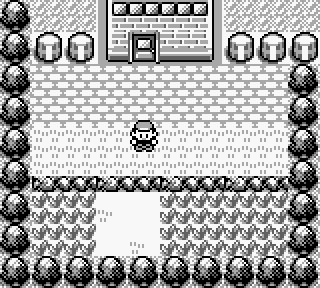
Individual objects within this scene can be determined by playing, but it's also often personally evident to conjure up your own interpretation of - not what the object is - but how it looks without the restriction of it's image size and pixel-use to you, and how such a small thing can play wonders with the imagination.

With the example above, I remembered - through playing and exploring the world for the first time, properly, since I was younger - that small, charming additions such as the trees, the blades of grass, the obstructions - of which I assume, but not sure, are concrete pillars - contribute towards a personal connection to the world and environment.
Minimal to today's standards sure - mainly because of the technological limitations of the Game Boy at the time - thus further explorations and releases of the franchises - as with most sequels and updates of games - strive to implement more graphical power, and thus, easily recognizable objects, trees and characters/creatures.

Of course, that's easier to suggest as technology has improved so much that it's simpler to have a realistic looking tree - at a specific size, and with a specific amount of sprites or polys - than it was back then.
And this leads me to recent video games, mostly independently released, through individual companies or teams, that appear to recently set the graphical presentation to the levels of games like the original Pokemon titles - Blue/Red/Yellow/Gold/Silver/Crystal - and provide old-school presentations, with elements that provoke throwbacks and nods to these technical marvels of days past.
Games such as, essentially, the entire selection from my previous post - albeit, some more than overs, in graphical representation; pixels/sprites - provide great influence in the way the game looks and the animation plays out - as intentionally basic as it may first appear.
With games like Home, the main character's animation is essentially a few frames strong, and as such has a quirky, charming approach to his walking. This choice, I feel, gives the player a sense of their own personal ownership of that character's movement, and how it impacts the player to the point that - in some cases - some animation can be so obscure, even if only walking, or jumping, or crouching, that it can generate a laugh, or a comment.

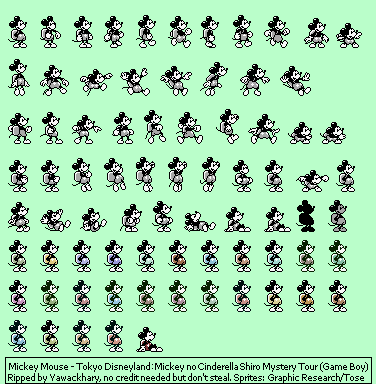
The crouching animation here for example - top right corner - appears to only be one frame, yet it's easily justifiable as to what Mickey Mouse is doing within that frame. The sprites are highly charming, in that they represent the classic Disney mascot in very limited frames. This reminds me of recent indie games, such as the ones in my previous post, and how they reflect these by intentionally taking the pixellated route as the style for their game, and give the impression that the game's from the Nintendo Entertainment System/NES, yet modified and released for the appeal of recent years.

It's almost as though the use of pixels within a game is an artistic direction, rather than a technological restriction, and games like Sword and Sworcery thrive on the artistic representation of a very modernized video game.

Saturday, 9 November 2013

Influences, Inspiration, Aspiration

I've been thinking about relevant and similar video games that highly incorporate that old/new-school feel.
These are released, and soon to be released, games that include features potentially beneficial to my project.

- Hotline Miami; old-school design with new-school visuals - pixels are manipulated into fast paced, humorous and 'art' style gameplay; based on and inspired by the film Drive.


- Home; 2D sidescrolling pixel-horror game with up-to-date SFX; mood represents current gen horror games like Amnesia or Resident Evil, with visuals complimenting NES and earlier-style video games.


- Dark Void Zero; more of a total retro-style game, with classic SFX, graphics and gameplay, implementing very little 'new-school' designs.


- Sword And Sworcery EP; up-to-date and 'hip' narrative styles; the dialogue is filled with slang and new-age referencing. The graphics represent that old-school style of pixels, yet used more as an artistic expression, and to make a fully realized, and expertly detailed pixel design. Fighting system is quick time-based and is new-school.


- Super Time Force; the soon to be released Superbrothers game has fast paced action, pixellated graphics and 'one-player co-op'. Super Time Force looks to further the humour and style of Sword and Sworcery, with a more accessible and arcade-like experience - points seem to be highly relevant with this game, like the appeal of arcade and pinball gaming.


- BattleBlock Theater; from the company that created Castle Crashers, this game carries on their quirky and unique visuals with old-school platforming and level design.


- Super Meat Boy; old-school character and game design with new school visuals, fast paced action, speed running, etc.


- Fez; based solely on pixels, very artistic, with the 3D-view switching ability to set it apart from most 2D platform games. though this game is mainly a casual game, with little to no conflict.


- Spelunky; from pixels to HD - the game has completely unique levels that randomize with every play, so that almost every play through is different/unique. Plays like a traditional sidescroller, with new-mixed genre inclusions such as RPG elements and the ability to exchange money for goods and weapons. Reminds me of Alex Kidd.


- Braid; an old idea; mainly Super Mario, converted into a brand new era, with completely reworked visuals that are traditionally artistic, with the ability to rewind time to puzzle solve - a unique feature that wouldn't have been possible in the old-school.


- EDGE; an isometric puzzle platform game with basic design of blocks, luminous coloured sections and a space-setting that sets it apart. The music has traditional synths and electronica-style sounds, the crisp HD design brings it to a new age.


Also worth mentioning/only just discovered;

- Risk of Rain


- Mercenary Kings


- Paradise Lost: First Contact


Sidenote.

HD conversations are often good for reigniting older audiences with a game, and also introducing new players through advertisements and word of mouth from people who've played it in the past. HD conversations are very popular and accessible to do these days, with multiple old-school games being re-skinned or recreated for new audiences.
Older companies and games that may have been lost in the past are updated to appeal to new players, and rekindle older players with their past playthroughs. Kickstarter and public funding have helped reignite passion for old-school games and franchises to be brought back, with well established companies such as Double Fine or renown game designers such as Keiji Inafune (the co-creator of MegaMan) seeking public funding for a brand new, fan-friendly video game.

Wednesday, 6 November 2013

Charm

So I remembered - and have kicked myself for only just - Gameswipe from satirical broadcaster Charlie Brooker. The show was a one off of his Screenwipe series and focused specifically on video games, influences and impacts through a short look of it's commercial and documented history, reviews, scandals, short discussions of video game genres and outsider input and opinions on specific games or aspects of games.
Upon rounding up his review of 50 Cent: Blood On The Sand for the Xbox 360, for example, Brooker said;

"...it's charmless; that's the main problem and games never used to be short of charm..."

Then proceeding to introduce Rab and Ryan to discuss their emotional connections with British homebrew video gaming growing up, in what they refer to as the "real retro".


The video snippet is a reflection of yesterday's talk with my course tutor, in which we discussed my current position within the project, and then threw around some ideas to help expand it into an actual prototype or product.
Throughout our brainstorming we discussed the concept of expanding on my previous project - Lima - if only for prototype's sake, of which nostalgic and satirical advertisement mockery could be placed within to form something to strive towards in the near future.
With the wonderfully emotion-evoking and nostalgia-driven new-age pixel-perfect game Sword and Sworcery EP at our midst, we used the themes and novelty within it to capture potential scenarios within my own prototype.
We knew that, in the centre of this whole prototype conundrum was the game itself, and spanning off where nostalgia-influenced outsider comments such as, '..OH, I like this, feels a bit like something, but not sure what...' and '...the way it plays, reminds me of...' as supportive reasoning and drive to include MAINLY these elements within the player's experience.

Charm is a key aspect that's often lost within big-budget, action-packed and quick-time event-filled videos games. Most of which, have become a staple for other mimicking releases, creating almost zombified, soulless experiences that offer dumbed down gameplay, 'hold your hand' pacing and extremely shoddy level design, wrapped around endless cut scenes and cinematics.

No, charm MUST be used as a staple, as a key for it's own independent statement, setting it apart from the packs of mindless clones and derogative narratives already out there.
I think that's what's lost - as Rab and Ryan discuss in the video above - the element of charm within games is often nonexistent. Yet, the growth and boom of the indie market, and the flourishing of non-publisher-needing teams and companies means talent is becoming a bigger thing than money, and it's exceptionally expressed through releases that cater towards their own personal visions and design.


'A camel is a horse designed by committee.'
- Sir Alec Issigonis


Monday, 4 November 2013

Oh, And..


I'd discovered this game back when I was playing Superbrothers: Sword and Sworcery EP. Yeah, 'back when' makes it sound like a decade ago I know.

Super Time Force is being developed by the same team - Capybara Games - with musical contributions from Jim Guthrie; the same singer/songwriter from Sword and Sworcery and looks to be another humour-filled, retro/old-school interpretation with an extremely modern twist and representation.

The newly released trailer above speaks for itself, but the concept of combining old and new - a current trademark within the company's video game library - alone makes me excited for the game's official release.

Upon exploring the team's OFFICIAL WEBSITE, I discovered recent updates on their NEXT next game 'Below' which looks to be spiritual successor to Sword and Sworcery.


"We started talking about this idea years ago, pre-Demon's Souls. Games like Spelunky, Dark Souls, Demon's Souls, FTL: they've done a bit of legwork for us in helping to prove out the idea that people want brutal, hard games that don't hold your hand and have something happen differently every time you play it."


The Masters Project, The Reevaluation Of

My potential plan throughout the year has already altered somewhat.

So, back before the course started I was job hunting, and almost acquired a position as GUI Designer. I, therefore, spent most of my time working with interface designs and narrative construction - how it worked; the page-to-page process/screenshots - and had only remembered my previous year's projects based mostly on nostalgia within my designs; thus applying MY own personal interpretation of how MY own games - concept wise - would look, feel, play and reward the user.
Video games, ever since I can remember, have influenced anything I've drawn, designed or played. Because of this, the passion to present personal tributes to moments and games passed have always been an aspiration and an emotional agenda of mine.
With that being said, nostalgia - therefore - was one of the first concepts uttered out of my mouth when classes began in September.

"Nostalgia."

I hadn't figured out, specifically, what I wanted to focus on with the project, I just knew the theme of nostalgia was potentially a major part of it.
I'd worked on concept art, games and level design throughout my third and final year of the Honors as the years proceeding it had rhythmically determined my own personal journey, and thus; yearn to study these specific areas.
With my concept and games designs - for my Honors project - I presented a game proposal, the influences, early concepts, and final designs into a year long project. Fluently the process was natural to me, and helped to cater further development on other potential projects - as concepts, character designs, world themes have always played a major part in my childhood narrative.

Or what I consider to be 'good' character design, or 'clever' level/environment design.

Honors seemed to be all about the actual creation of a project, with influence and research being a small part of the process - to me anyway - whereas, so far, Masters goes for brains, and the thought-provoking processes of creating something; how an idea is thought up, and the constant and consistent dissecting and analyzing of what can be considered 'good' and 'clever' with relevant evidence and feedback, to then implement these ideas and reasoning into said creation.
For me, the older and more recent retro-feel video games have always been an interesting area to dissect - as, growing up with the early renditions of Nintendo and Sega warm the cockles of my heart, and will continue to do so. Yet, it's the yearn, that mystery of what, therefore, nostalgia is, how emotion is triggered from memories past, and what influencing designs can I create, based on these.
The concept of nostalgia, and it's inhabitants within all of us, is a keen topic to explore.

Recently I've been fascinated with the satirical advertisement agenda - not specifically the use of advertisements in video games, though some have catered specifically towards satirical mock-ups within their designs, Bioshock comes to mind - but how influential advertisements and potential propaganda-based marketing can affect it's audience, within a game.
The use of They Live's bold, satirical mocking of our consumerist society for example provided the kind of concept that I'd like to research, analyse and discuss, and the idea of a finished product at the end of next year is a daunting yet exciting one as this is a potentially whole new prospect within design that I'd always noticed, but never studied and used knowingly in design.

This, however, WILL coincide with nostalgia. It will be great to blend both concepts into each other, whether it'd be based around specific years and time periods, for example, that encapsulate and reimburse the idea, overall, that will then be presented in an end of year design.

Saturday, 2 November 2013

Brazil

I watched the 1985 Terry Gilliam classic Brazil today as I'd been contemplating and rationalizing on expanding the criteria I can discover and discuss around satirical entertainment such as this. Brazil is an ambitious film. Hell, this is obvious by it's critical acclaim and cult status; one of the main reasons I picked it out to watch - it's ridiculous it's only now that I've watched it. I think reading on reviews, critical and personal analysis on the film initially put me off, the stills/screens and trailers I'd seen in the past where brushed off as, 'probably not my type of movie, very art-house, bizarre; tough to get into', to which now, ironically, I've succumb to enjoying within films.


It's always a strange feeling, when watching or playing something and it completely deludes the mentality that you initially had beforehand. Not that I often judge a book by it's cover, so to speak, it's all subjective, and all based on taste, and individual perspectives on experiences we've loved, hated, accepted or been nonplussed by in the past to then establish a personal opinion.

After watching Brazil, and becoming instantly ore-inspired by the time the end credits scrolled up the screen, I began delving into other sources of media out there that I was initially already aware of; such as films and games, recent and past - that I thought would fit the same sorts of narrative exploration and meaning. Narrative metaphor and satirical structure within entertainment - especially when handled so expertly - makes me, as the viewer, and the audience, want to explore the further reaches, messages and intentions of the experience.
My previous post is based on my potential expansion within the nostalgia-based project; that of advertising and the often intentional corrupt campaigns and propaganda-based agendas - there of - that are satirically explored and entertainingly exploited in films such as They Live.

With Brazil, however, it wasn't as 'in your face' with it's message; it had to be explored. The comedic element surround They Live's plot was based around boxes of sunglasses that could 'awaken' the wearer so that the truth was blatantly advertised. Brazil's world is derived from a dystopian standpoint, and focuses on the weird and wacky elements such as pantomime-esque characters and environments that also seem to become living creatures themselves.
Metaphorically these films serve as a yearn to escape, like living in a constant dreamworld that's often devoid of human emotion; pitting the main character as someone who looks through the looking glass and discovers the world they're surrounded by, all of a sudden is as bizarre and inhuman as we the viewer see it as.
The realization often drives the emotion of a film, and gives the viewer a personal and human connection to the character - the struggle to get out of this desolate living and finally find freedom; happiness.

Seems to be a theme with dystopian settings; I've noticed this trend in many other films - futuristic and noir-like - such as Blade Runner, The Warriors, Tron, The Truman Show, etc. Other forms of media - specifically video games - have been known to replicate and borrow from some of these classic, genre-refining cultural pieces; Deus Ex and the original Unreal Tournament/Quake III: Arena, for example.